

This week's roundup: REALM Group Freight, Cattle feedlot industry, Volvo Masters Asia, Costs Surge, and more updates. Plus, fresh listings, auction dates, and more from across Australian ag. Let's get into it →

REALM Group Freight is an Australian-built digital marketplace where farmers, buyers and freight operators trade agricultural commodities through three flexible selling modes — List It, Sell It, or Auction It — with carrier logistics and Stripe-secured settlement built in.
What it is:
A production-grade B2B marketplace platform for agricultural commodities, purpose-built for Australian primary producers, buyers, and the carriers who move freight between them. Live at realm-ag-marketplace-production.up.railway.app, operated by REALM Group Tech.
The three seller flows:
👉List It — open marketplace listing, buyer enquiries, parties negotiate
👉Sell It — fixed-price instant purchase via Stripe Checkout
👉Auction It — English ascending auction with optional reserve price and optional Buy Now, $10 bid increment, hard close at deadline, automatic conversion of winning bid into a payable order
What makes it different
End-to-end loop closed — listing, payment, freight, and audit trail all in one platform; sellers don't need to bolt on separate logistics or escrow tools
Verified carrier network — REALM-onboarded freight operators visible alongside listings, removing the "now how do I move it?" friction
Live Stripe settlement — real payments, real payouts, not a demo skin
Configurable fee model — per-listing or per-mode commission, ready for white-label partner shopfronts
Built on modern infrastructure — Next.js + Supabase + Stripe + Railway, with row-level security and an admin review queue from day one
Why it matters:
Australia's ag trade is still fragmented across phone trees, paper tickets, and disconnected auction houses. REALM gives sellers the choice of selling style on a per-listing basis — list it to test the market, sell it for instant cash, or auction it when there's competitive demand — while keeping freight, payment, and audit in one place.
Designed, developed and deployed by REALM Group Global — a multi-entity ag-tech and logistics group operating across Australia, the United States, India, Uganda, and Canada. The marketplace is part of a broader REALM stack that includes the carrier network (REALM Group Freight), the REALM360 platform, and partner data tooling.

📈 MARKET PULSE - 2026 Commodity Outlook:
Cattle feedlot industry

Key points
Feedlots and grain-fed beef production are becoming increasingly important for Australian beef production.
Feedlots play an important role in smoothing out Australian beef production and export availability.
Grain-fed cattle have made up a growing share of Australian beef exports over the last two decades.
Drier seasonal conditions in 2023–24 are expected to increase the number of cattle in feedlots.
The Australian cattle feedlot industry is steadily growing
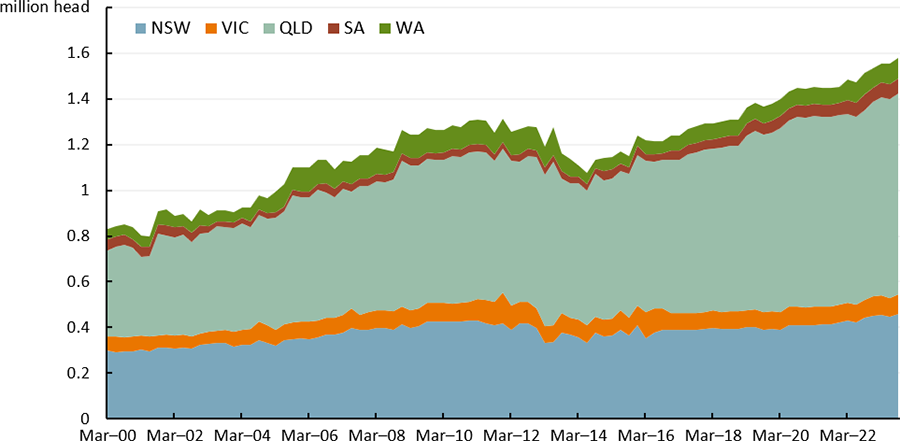
Australia’s cattle feedlot industry has been steadily growing over recent decades, driven by sustained growth in Queensland (Figure 1.1). Over the last decade, the industry's capacity has grown by 36%. Queensland has led the increase in capacity (up by 49%, or around 289,000 head, since September 2013), followed by New South Wales (up by 21%, or around 81,000 head).
Figure 1.1 Quarterly feedlot capacity by state
Source: ALFA
Growth in the cattle feedlot industry has primarily been driven by larger feedlots. The average number of cattle on feed at large feedlots (with more than 10,000 cattle on feed) has grown at an average of 5% per year over the last decade, while the number of cattle on feed at small feedlots has declined. The shift is likely driven by the improved efficiency and competitiveness that can be realised by operating a larger feedlot.
Feedlots are an integral component of Australia’s cattle production pipeline
Historically, feedlots have played a role in ‘drought proofing’ Australia’s beef industry. Feedlots help Australia provide a consistent supply of beef to both domestic and export markets, as well as an option for farmers to ‘finish’ cattle that may not otherwise meet processor specifications. While cattle turn-off from feedlots has remained stable in absolute terms, it has increased as a proportion of total cattle turn-off in Australia. During years with good seasonal conditions, such as the period from 2020 to 2023, feedlots’ share of total turn-off typically increases. This reflects lower grass-fed cattle turn-off as farmers look to rebuild their herds.
The ability for feedlots to maintain a consistent cattle turn-off despite changes in seasonal conditions is beneficial to Australia’s beef production system as it provides Australia and major trading partners with a more consistent supply of beef products. For example, during drier years when herd destocking is occurring, feedlots ensure that Australia continues to be able to service beef demand from our key export markets. As such, feedlots play an important role in Australian cattle production (Figure 1.2). In the September 2023 quarter, feedlots accounted for around 30% of Australia’s total quarterly cattle turn-off. In Queensland, the largest cattle-producing state in Australia, feedlots represented 39% of total cattle turn-off in the September 2023 quarter.
Figure 1.2 Quarterly cattle turn-off
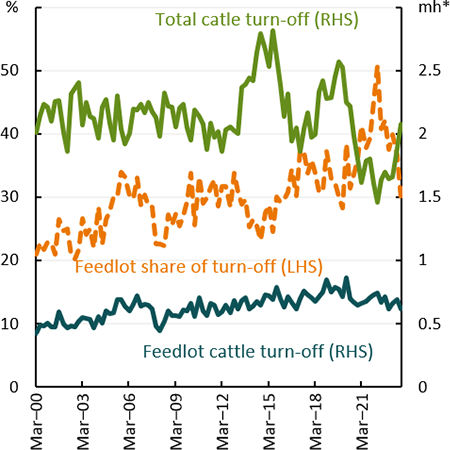
Note: *million head; Turn-off refers to the sum of cattle slaughter and live exports.Source: ABARES; ABS; ALFA
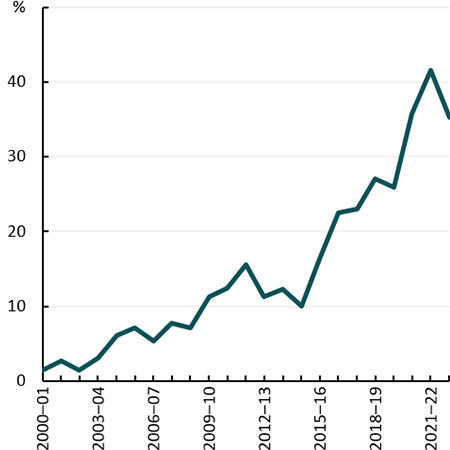
Figure 1.3 Proportion of annual Australian beef exports that are grain-fed
Source: DAFF; MLA
Grain-fed beef exports are rising
Australian grain-fed beef exports have become an increasingly important component of Australia’s beef exports. Over the decade to 2022–23, grain-fed beef exports have risen from 11% of total beef exports to 35%, reflecting the growing proportion of cattle on feedlots (Figure 1.3). The share of grain-fed beef exports peaked at 42% of exports in 2021–22. This peak was driven by favourable seasonal conditions and strong pasture growth, which led to significant herd restocking in Australia. As a result, lower numbers of grass-fed cattle for slaughter reduced grass-fed beef production and exports. The ongoing growth of Australia’s feedlot sector is expected to support the reliability of Australia’s supply of exportable beef products by dampening the effect of seasonal conditions. This, in turn, is expected to incentivise importing countries to purchase Australian products.
🚜 AG MACHINERY
Volvo Masters Asia Final showcases technical excellence

The Masters 2026 Region Asia workstations at PT Indotruck Utama’s (ITU) facility in Cakung, Indonesia. Images: Volvo CE
Volvo CE recently hosted the Masters 2026 Region Asia Finals in Jakarta, Indonesia, bringing together seven of the region’s top dealer teams for an intensive competition focused on technical expertise, teamwork, and problem-solving in aftersales.
Held at PT Indotruck Utama’s(ITU) facility in Cakung, Indonesia, the event welcomed participants from Korea, Indonesia, Malaysia, Taiwan, the Philippines, Singapore, and Vietnam, reflecting the strength and diversity of Volvo CE’s dealer network across Region Asia.
Testing real-world service capabilities
Across two days of competition, teams rotated through four technical stations, each designed to replicate real-world service and maintenance scenarios:
Excavator Station
Articulated Hauler Station
Wheel Loader Station
Engine Station
At each station, teams were tasked with diagnosing and resolving faults within a fixed timeframe, using Volvo diagnostic tools and applying their technical knowledge under pressure. The format mirrored the challenges faced on actual job sites, where quick, accurate troubleshooting and effective teamwork are critical to maximising uptime and supporting customer operations.

Masters 2026 Region Asia Final participants.
Recognising the region’s top teams
Following a closely contested competition, the final standings were:
1st place: Team ITU, Indotruck Utama, Indonesia
2nd place: Team KSS, Korea Sales & Service, South Korea
3rd place: Team Volvo CE Singapore, Volvo CE Singapore, Singapore
The top two teams will represent Region Asia at the Volvo CE Masters 2026 World Final, taking place in September at Eskilstuna, Sweden.
Volvo CE Head of Uptime and Parts, Gerard Lim, said every team came prepared, not just to compete, but to challenge for the crown.
“The level of readiness, focus, and determination was outstanding, and it created an intensely competitive environment that truly reflects the strength and ambition of our dealer network across Region Asia,” he said.
Building technical excellence for customers
The Volvo CE Masters 2026 Region Asia Finals competition played a key role in developing technical capabilities across the Volvo CE dealer network, helping technicians refine their diagnostic skills and stay up to date with evolving technologies.
By focusing on practical, hands-on challenges, the competition reinforced Volvo CE’s commitment to delivering reliable performance, efficient maintenance, and strong after-sales support for customers in the region.
💰 PAY IN-TIME FINANCE
Australian Agriculture Update: Costs Surge, Crops Shift, and Farmers Tighten Up
This week, pressure across Australian agriculture has intensified again — and the impact is now clearly flowing through to planting decisions, cashflow management and long-term farm planning.
One of the biggest developments this week has been growing concern around fuel and fertiliser availability heading into the winter crop season. Across several grain-growing regions, higher diesel prices and tighter fertiliser supply are already influencing what farmers choose to plant, with some shifting away from nitrogen-heavy crops like wheat toward barley, pulses and canola to reduce input exposure.
At the same time, winter crop plantings are expected to soften nationally as producers respond to rising operating costs and uncertain supply chains. Fuel remains a major issue, particularly in regional areas where delivery delays and higher transport costs continue adding pressure to already tight margins.
Despite the tougher environment, there are still positive signs emerging.
Global grain markets have strengthened due to overseas drought concerns, while Australian beef prices continue to hold firm on the back of solid export demand. Australia’s agricultural sector also remains heavily export-driven, continuing to support long-term confidence across the industry despite current volatility.
What’s changed most this week is the financial mindset.
Farmers are becoming increasingly proactive — refinancing existing facilities, consolidating debt, reducing repayment pressure and preserving working capital wherever possible. The focus is no longer growth at any cost; it’s about staying efficient, liquid and operationally strong while conditions remain volatile.
In this environment, Pay In Time Finance continues working alongside Australian farmers to restructure lending, align machinery and equipment finance with seasonal income, and help businesses reduce financial pressure while maintaining momentum.
The operators making disciplined, early decisions now are the ones positioning themselves strongest for the months ahead.

📰AGRICULTURAL NEWS AUSTRALIA
Don’t wait for electric tractors: is there a case for electrification in Australian farming?
Australia’s diesel squeeze is re-examining the potential case for farm electrification, but pumps, cooling and other equipment are shaping as more likely electrification candidates than heavy, mobile machinery.

Key points
Fuel supply disruption is putting fresh pressure on diesel-reliant sectors, with agriculture among the industries most exposed in regional Australia.
Farm electrification looks more immediate in pumps, cooling, hot water and smaller equipment than in the biggest broadacre machines.
Mining is already trialling battery-electric haul trucks, but farming’s transition is likely to be slower, more selective and more dependent on where the economics work.
Australian farmers may be years away from following miners into battery-powered heavy vehicles, but the current fuel squeeze is putting a more immediate question on the table: what equipment on the land can move off diesel now?
Fuel supply disruption has pushed the issue into sharper focus, with the federal government saying global events are hitting supply chains, particularly in regional areas and in sectors including agriculture, transport and maritime.
Canberra has responded by cutting minimum stockholding obligations by 20 per cent, making up to 762 million litres of additional diesel and petrol available to the market, while also moving to relax diesel standards for six months to lift supply.
For farming, that does not suddenly make electric tractors a near-term reality. But it does strengthen the case for switching some pumps, cooling systems, hot water and smaller vehicles away from diesel where the economics stack up.
Agriculture deeply reliant on diesel
Australia’s agriculture sector remains deeply tied to diesel. A NSW Department of Primary Industries report found Australian agriculture consumed 85.9 petajoules of diesel in 2019, equal to 2,225 megalitres, and said diesel made up more than 80 per cent of the energy consumed by agriculture in NSW and nationally.
The same report says a small share of high-power systems, which are used only occasionally, are likely to stay diesel for the foreseeable future.
A different path from mining
Mining is already further down the electrification track. In May 2024, BHP and Rio Tinto announced they would collaborate on trials of large battery-electric haul trucks in the Pilbara, including tests of battery, static and dynamic charging systems. In December last year, BHP said the first Caterpillar battery-electric haul trucks had arrived at Jimblebar for on-site testing.
But mining’s use case is quite different to agriculture’s. Mining fleets are concentrated on large sites, run hard and can justify major charging infrastructure. Farm machinery is more dispersed, more seasonal and often works across long distances, which makes electrification of the biggest machines harder to pull forward.
Where farms can move sooner
Government and industry programs suggest the most practical potential electrification gains for farmers are in stationary and lower-power equipment. Agriculture Victoria has run on-farm energy assessments since 2018. The majority of those assessed since then have been dairy and horticulture farms, with common recommendations including solar PV, variable speed drives, more efficient equipment, heat recovery and operational controls.
The CEFC and National Farmers’ Federation have also pointed to irrigation, pumping, heating and cooling, machinery upgrades and precision agriculture as areas where clean energy can lower energy use and improve productivity. The CEFC says energy is one of the sector’s fastest-growing costs.
In irrigation, the numbers can be tangible. A CEFC case study on the Darling Downs found a 25kW solar system supporting an 18kW bore pump cut annual electricity costs by $8,000, for example.
There are also operating benefits beyond the fuel bill. The NSW DPI report found maintenance costs for a diesel pump are almost double those of an electric pump, with diesel pumps more labour-intensive and harder to operate remotely.
Not a simple switch
All of that does not make electrification straightforward. A 2024 NSW pilot with dairy farms found thermal storage and solar-powered cooling systems could reduce peak electricity demand and energy costs, but said the financial results fell short of expectations, underlining that technology alone does not guarantee savings.
That may be the most important point for agriculture right now. The electrification opportunity is real, but uneven. Some farm systems look ready for change. Others still depend on diesel and may do so for years.
For now, the current fuel disruption may be less a trigger for an all-electric future than a reminder that energy choices on the farm are becoming more strategic. In mining, the headline story is battery-electric haul trucks. In agriculture, the quieter shift may be in pumps, cool rooms, hot water, sheds and smaller machines that can be electrified earlier, and with less disruption.
📅 WEEKLY AUCTION DATES – 2026
Starts: 26/05/2026, 08:00 am
End: 28/05/2026, 08:00 pm
Click here to see the list of upcoming auctions at www.realmgroup.com.au/auctions
📝 FIELD NOTES WITH RD CREATIVE STUDIO
What "Being on Google" Actually Means Now
Buyers aren't searching the way they used to. They're outsourcing the watching.
A few people came back after last week's piece. Most had run the check (they typed the question their best buyer would ask into ChatGPT or Claude and found out something about where they stood). A handful said they'd always assumed Google was covering that side of things anyway.
That assumption is worth revisiting.
Buyers Are Now Delegating Discovery
Google announced this week that buyers can set it to watch the market on their behalf. They describe what they're after — something like "let me know when a used chaser bin comes up in the Riverina" — and Google watches. They get on with their day. Google flags them when something matches.
They don't search again. Google searches for them.
That's a real shift in how a buyer moves through a decision. They're not sitting down every week actively looking. They set a watch, get on with the season, and wait. By the time they reach out to a seller, Google has already been building their picture of who's in the market and what those businesses look like.

Visibility Is Becoming Continuous
Buyers aren't searching the way they used to. They're outsourcing the watching.
This is the part most businesses still underestimate.
Most operators still think about online visibility as something that happens at the moment of search. Someone searches, you appear, and a decision gets made.
Increasingly, it works more like a reputation layer running quietly in the background. Systems absorb information continuously, refresh their understanding, and decide what deserves surfacing when a buyer's intent eventually shows up.
Which means businesses are no longer only competing at the moment of search. They're competing in the period before it.
Run This Instead
Open Google and type the actual question your best buyer would ask. Not your business name. The real question.
Then look carefully at what appears before the links, like which businesses get surfaced, how they're described, what Google seems confident about, what categories it associates with them, and what it ignores entirely.
That's a version of the layer buyers increasingly work from before they ever actively start comparing suppliers.
The Operators Who Usually Handle These Shifts Best
The operators who navigate these moments well aren't usually the ones chasing every new tool the fastest.
They're the ones who notice buyer behaviour changing early, then adjust before the market catches up.
Right now, the biggest shift isn't AI itself. It's that buyers are beginning to outsource the watching to systems that never stop.
If you want to understand what those systems are currently piecing together about your business, the team's been deep in this work.


🤠 RINGERS FROM THE TOP END (RFTTE)
Link to the answer of the bull weight: https://rfttejobs.news/BettiniBull
G’day REALM Readers...
I've been doing a few Ag Career Days at schools around NSW recently and, to get the students interested, I usually run a "Guess the Bull Weight" competition.
Most of the kids enter to get a free RFTTE trucker cap, while the closest guess scores a gift voucher from our generous mates at Kent Saddlery.
But the best part? It gets the students asking questions without even realising it...
“How old is he?”
“What breed is he?”
“Where’s he from?”
“What's that hump on his back?”
Suddenly they're talking agriculture, cattle, genetics, stations and the bush. That’s what it’s all about.
This fella comes courtesy of Luke at Bettini Beef’s De Grey Station in the Pilbara region of WA. He’s a 3-year-old bull from Carinya Brahmans with a generally quiet demeanour and, as you can see, he’s currently in his working clothes alongside some white tag heifers waiting to head back into the paddock.
So... have a crack at his weight in kilograms and see how close you get. The answer is at the bottom of the newsletter - no prizes, just bragging rights!
And no... luck is not a factor;)
Hooroo for now,
Simon Cheatham
Founder RFTTE - The Online Campfire
0417 277 488 | [email protected]


📷 SAMANTHA WATKINS PHOTOGRAPHY
REALM Group Australia is proud to sponsor amateur photographer Samantha Watkins. We've seen her photography skills grow tremendously over the years, and we believe it's the perfect time for her to step into the photography world.

Click on the link to take you to her FB photography page, where you can see her beautiful photos: "Samantha Watkins Photography" on Facebook.
https://www.facebook.com/profile.php?id=61573116870308

All photos are available for purchase – simply email [email protected], and she will be happy to assist you.'
🚨 FEATURED LISTINGS THIS WEEK
Check out our latest machinery, livestock, and equipment listings below. New items are added weekly from farmers across Australia.

(9018) [Like New] - Fully Furnished Donga 3m x 12m

(9065) 2018 Vawdrey drop deck 43'
→ View all For Sale listings at www.realmgroup.com.au/listing/for-sale
→ View all Under Auctions at www.realmgroup.com.au/listing/under-auction
→ View upcoming Auctions at www.realmgroup.com.au/auctions
🏘️ YOUR TOWN
Robbie is definitely 'that guy!' He's even got his own cartoon character.

Follow us on Facebook and join ROBBIE’S REALM and tell us why Robbie should come and visit YOUR TOWN!
🎙️ NEW PODCAST - TALKIN' SH*T
Ideas Paddock Podcast - Hosted by Robbie and Ramo. From Fertiliser to Finance - We Tell It Like It Is! Subscribe to YouTube and never miss an episode.


Join the IDEAS PADDOCK community and have your say!
What's your biggest challenge this season?
Cheers,
The REALM Group Australia Team
