

This week's roundup: WA farmers seeding, Australia to reap larger wheat crop, Optimize Guidance Lines, Weather Volatility Returns, VicGrid surveyors, and more updates. Plus, fresh listings, auction dates, and more from across Australian ag. Let's get into it →
WA farmers seeding their 'riskiest crop in years' welcome early rain

Reuben Smith checks his rain gauge in the Wheatbelt region of Western Australia. (ABC Great Southern: Mark Bennett)
In short:
Widespread rain has delivered timely relief to grain growers across parts of the southern Wheatbelt. Farmers say this season has been among the riskiest they have faced, with geopolitical tensions adding a layer of uncertainty.
What's next?
Growers say there are concerns about whether fuel supplies will be sufficient for the 2026–27 harvest later in the season.
Grain growers across parts of southern Western Australia have welcomed an early seasonal break, amid significant uncertainty caused by ongoing tensions in the Middle East.
Rainfall earlier this week was widespread across isolated areas, with Hopetoun in the Southern Coastal region recording more than 20 millimetres, while the Great Southern had similar amounts, according to the Bureau of Meteorology.
Lake Grace farmer Reuben Smith said the recent rain on his property — which recorded 18 millimetres earlier this week — brought welcome relief after an unpredictable start to the season.

Reuben Smith says the recent rain has been a welcome sight. (ABC Great Southern: Mark Bennett )
"This rain is really, really relieving," Mr Smith said.
"Planning in the lead-up to seeding, there were definitely a few spanners thrown in the works.
"There was so much angst, not knowing if we were going to get the right amount of fertiliser, or fuel, and not knowing how that was going to affect our seeding programs.
"But now it's settled down a bit, since we've got bums in seats and actually started seeding. This rain is great."

Reuben Smith says the rainfall has been "patchy" so far this season. (ABC Great Southern: Mark Bennett)
The Wheatbelt farmer said the start of the 2026 season had been “patchy” in terms of rainfall, though he did receive some earlier in the year following ex-Tropical Cyclone Narelle.
"When Cyclone Narelle came down, we managed to jag around 17mm," Mr Smith said.
"Before that, we've had a little bit but not a great deal.
"Fingers are definitely crossed for more."
'Challenges farmers haven't seen before'
Agronomist Ben Whisson said the rain was a strong start to a season he described as unlike anything he had ever seen before.
"It's been very uncertain with some challenges that we haven't seen before," he said.
"Pricing fluctuating that comes and goes is not unusual.
"But … supply has been so uncertain, and whether we would actually get our seeding supplies at all has been too. We haven't seen something like that, I don't think ever, in my experience."

Ben Whisson says this year has been extremely challenging for farmers in the lead-up to seeding. (ABC Great Southern: Mark Bennett)
He said compared to last year's record crop, it could be a different outlook this harvest season, not only due to supply constraints but also because of an increase in prices across the board.
"We are looking at a very different scenario. We've had a lot of seasons where the budgets don't look very good in February, but the seasons have been relatively kind, and it's rained, and we've been able to generate some good crops and some good returns, whereas as the prices keep going up, the risk keeps going up," Mr Whisson said.
"This is why when you are talking to a lot of people at the moment, they'll say this is the most risky crop they've put in for a long time, not just because of supply, but because … the cost of putting the crop in just keeps escalating.
"We don't know whether there's going to be enough fuel later in the season, but we have enough at the moment, so we need to continue under those circumstances."
In WA's South West, Boyup Brook farmer Ben Creek said his spirits had been lifted by the recent rain.
"We're looking at around 31mm for April, which is a great start and looks like it is an early break," Mr Creek said.
The mixed grain, sheep and cattle farmer said that despite the uncertainty when it came to grain, the sheep market had offered him some optimism.
"To have wool prices and lambs where they are now, that is the spirit-lifters we need," Mr Whisson said.
"It's encouraging, put it that way."
📈 MARKET PULSE - 2026 Commodity Outlook:
Australia to reap larger wheat crop, export restrictions to counter supply pressure
This is part of the COMMODITIES 2026 series, where our reporters bring you key themes that will drive commodities markets in 2026.
Australian wheat prices are expected to exhibit more bearishness in early 2026, as they track significant global wheat supply, though export capacity limitations due to strong sales of other winter crops could support prices.
Australian wheat prices were largely rangebound for much of 2025, as thin imports from China, alongside economic and demand concerns, curbed buyer appetite for forward coverage, based on data from Platts, part of S&P Global Energy.
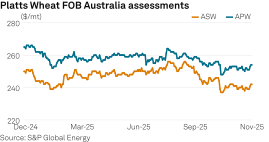
Australia is on track to reap a larger wheat crop following improvements in weather across most states, according to the Australian Bureau of Resource Economics and Sciences. ABARES pegged MY 2025-26 wheat production 4% higher at 35.6 million mt in its latest report Dec. 2, on the lower end of trade estimates at 35-37 million mt, according to Australian exporters.
"Our expectations for [MY 2025-26] Australian wheat production are 35.6 million mt – aligned with ABARES following their December publication. As we have flagged in our recent reports, we believe USDA at 36 million mt is unlikely given it is difficult to realise such strong yield gains this late in the season," said Vladimir Zinkovski, senior principal analyst and head of APAC Crops at S&P Global Energy CERA.
Higher average crop protein is expected in the East Coast and South Australia compared to Western Australia, according to regional grains traders.
"We will be seeing lots of Australian Standard White with 9% protein grades (ASW9) and similar grades in WA, which is very much expected. The quality in northern New South Wales is very good, and Australia Hard 2 (AH2) is the dominant grade by far," said a Victoria-based trade source, who added that the Western Australian crop profile could mirror that of MY 2024-25.
Zinkovski noted that protein dilution could be less than expected in Western Australia, but expects a higher proportion of ASW and, to some extent, APW, at the expense of higher-protein grades in the state.
The profitability of other winter crops may discourage Australian wheat sales in the near term, as it consumes shipping capacity and results in less competitive prices for Australian wheat in Southeast Asia, according to Asian millers and grains traders.
Black Sea exports to Southeast Asia drop in 2025
Notably, 2025 saw a marked decline in bulk wheat shipments from major Black Sea exporters to Southeast Asia, based on S&P Global Commodities at Sea data.
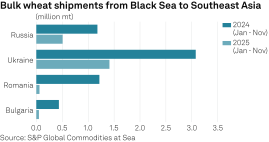
Between January and November 2025, Ukrainian and Russian bulk wheat shipments to Southeast Asian countries fell at least 50% year over year, while Bulgarian and Romanian shipments suffered even larger declines at 88% and 95%, respectively, CAS data showed.
Asian wheat buyers had shied away from Black Sea wheat after issues with shipment delays and high spot prices between July and August, driven by an unexpectedly higher protein crop harvest, which reduced the availability of feed wheat for exports, and a surge in spot demand from government tenders in the Middle East and Africa, according to multiple Asian wheat trade sources.
Nonetheless, Asian grain traders have noted that thin offers for Australian new-crop wheat are now benefiting Black Sea exports, which are drawing interest from Asian buyers for shipments up to the early first quarter of 2026.
Global grains production rises, demand concerns persist
As 2025 comes to a close, the narrative of a heavy supply, stagnating demand, and rising corn production continues from 2024, with higher global grains production projected year over year by the US Department of Agriculture's World Agricultural Supply and Demand Estimates report released Dec. 9.
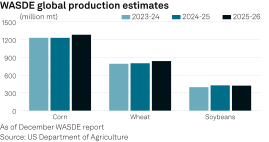
Meanwhile, Asian trade sources and millers continue to highlight concerns around domestic downstream demand and weak Chinese imports as a hurdle toward milling wheat consumption growth in the region, with mills exploring regional flour exports to diversify demand streams.
"We are expecting Southeast Asian flour millers to maximise imports in [MY 2025-26], given ample global supply and competitive prices, particularly from Argentina, which will set the price floor. As a result, we may expect more deferred business from [flour] millers," said Zinkovski.
In 2026, upside risks to wheat prices remain despite a global supply glut, due to non-wheat crops competing for export capacity, said several wheat exporters.
This has already been observed in US wheat prices, where corn and soybeans were prioritised at US Pacific Northwest ports, and may hit major canola and barley exporters, Canada and Australia, the sources added.
🚜 AG MACHINERY
Optimise Guidance Lines to Cut Fuel Use and Overlap

FENDT
GPS guidance and autosteer systems eliminate field overlaps and skips, and reduce total field travel time, improving efficiency and reducing fuel consumption. Field-traffic patterns and the associated turns can be carefully optimised, provided that the right data is readily available in the cab.
The operator first needs to establish a predefined path — the AB line — when starting a field. This AB line determines the parallel machine passes within the field, which can be saved within the in-cab display for future retrieval and use. This is where poor planning practices can create problems.
Check AB Lines Before Hitting the Field
“Start planning before hitting the field,” said Blake Bullinger, senior marketing product specialist at Fendt. “The reality is, we pick our varieties, we pick our fertiliser plan, but do we sit down and clean up the guidance terminals? Do we have random AB lines that were created to complete small tasks last year, cleaned out? Maybe there is a time when you set an AB line for a task that you normally wouldn’t do. Go back and double-check that those AB lines that you don’t want to use are cleaned out and not creating clutter in the terminal.”
“Do we have all the tasks loaded into your farm management software that will be pushed to the tractor? Are all of the machines synced up to one platform so you’re not trying to juggle multiple platforms? Having a plan when you go to the field makes it easy on the operator,” said Bullinger. “If you are the operator, it makes it easier on you.” This eliminates the guesswork.
“It starts with making sure that the plan is cleaned up and accurate,” said Bullinger. “It takes 10 extra seconds when making the AB lines to name them. It will really save a lot of time on the backend. I have been guilty of that. It is one of those lessons you learn once.”
The goal is to optimise the path through the field. “If we can reduce the number of turns, if we can reduce the overlap passes, that will not only speed the work up, but will also increase efficiencies,” he said.
Cut the Clutter
After several seasons, old data can build up in your guidance systems.
“One of the biggest challenges for growers is ending up with a hodgepodge of AB lines in their display,” said Luke James, dealer success manager at Ag Leader. “It’s much easier when everything is in one platform on a single map. From there, you can delete unnecessary lines, rename them, and organise them into guidance groups for specific operations, like 2026 planting lines, so you can optimise for efficiency.”

Having the AB lines and plan clearly set up before entering the field will prevent confusion and delays.Ag Leader
When you enter the field, having the AB lines and plan clearly set up prevents confusion and frustration. In the case of Ag Leader, the data flows into the AgFiniti platform that is accessible on a computer, tablet, or smartphone. The data is then distributed back out to the in-cab displays. It is a cloud-based platform that enables wireless file transfer, real-time mapping, and data analysis.
API connections ensure data can be shared across multiple platforms from various manufacturers for compatibility with mixed fleets. The data is automatically brought in from the display and processed. Through the AgFiniti platform, you can manage field boundaries and guidance lines, and rename them, so they are easier to pull up in the cab’s display.
“You can clean them up on your desktop before you download them to equipment in the field,” said James. “This optimises your efficiency.”
Consolidate Data
Having data stored in several different locations makes it difficult to identify opportunities.
“It is more critical than ever to have everything — from your planting data to your application data, to your harvest data — all in one platform,” said Bullinger. This allows maps to be overlaid to identify areas for improvement. “It allows you to do your own trials. Cross-platform operations management software, such as PTx FarmEngage, can integrate data from multiple brands."
One area of opportunity that may be explored when looking at the consolidated plan is combining field operation passes. “With tractors that are running a front 3-point hitch or front PTO, is there a way to combine a pass to reduce the total number of passes?”
💰 PAY IN-TIME FINANCE
Australian Agriculture Update: Weather Volatility Returns and Planning Tightens
This week, Australian farmers are once again dealing with what defines the industry best— unpredictability.
Across parts of the East Coast, conditions have shifted quickly, with some regions receiving useful rain while others are seeing uneven coverage and lingering dry patches. For many producers, it’s creating a stop-start environment where timing decisions around planting, feeding, and transport are becoming more critical by the day.
At the same time, labour and logistics continue to play a bigger role in day-to-day operations. Delays, availability, and rising costs are pushing more farmers to rely on systems and equipment that improve consistency, rather than just capacity. The focus isn’t on doing more — it’s on doing it reliably, every time.
There’s also a noticeable shift in mindset this week. Farmers are planning further ahead,stress-testing cash flow, and making decisions with a stronger emphasis on flexibility. Whether it’s holding stock longer, adjusting planting schedules, or spacing out capital purchases, the theme is control.
Financially, more producers are reviewing their current position. Refinancing existing loans, reducing repayment pressure, and using available equity to create breathing room are becoming more common — not out of distress, but as a proactive strategy.
In this environment, Pay In Time Finance continues working alongside Australian farmers to structure lending and equipment finance around seasonal income cycles, helping maintain stability while conditions remain uneven.
As always, those who stay adaptable, structured, and forward-thinking are the ones best positioned to navigate whatever comes next.


Smarter Livestock Transport Starts Here!🚛
Say goodbye to inefficiencies and hello to smarter freight solutions with StockShift — the platform transforming livestock transport across Australia 🇦🇺
Whether you're a producer, agent, or transport operator, StockShift helps you:
✔ Reduce empty kilometres
✔ Improve load efficiency
✔ Streamline your operations
No more guesswork — just faster, more reliable transport coordination that keeps your business moving forward.
📲 Download StockShift today!
🌐 www.stockshift.com.au
📰AGRICULTURAL NEWS AUSTRALIA
VicGrid surveyors cancel access visit after farmgate protest makes them feel unsafe

Ben Duxson addressed his supporters after VicGrid drove past his property and declined to stop. (ABC News: Tamara Clark)
Renewable planning body VicGrid has threatened a high-profile anti-transmission-line campaigner with enforcement action after government surveyors felt "hindered" from accessing his farm.
Marnoo farmer Ben Duxson is one of the most vocal opponents of the VNI West Transmission Line Project.
On Monday, he and 80 supporters gathered behind his farm gate, waiting for VicGrid officers to attempt to access his property for an environmental survey.
But Mr Duxson says when the surveyors saw the crowd, they sat in their car for a few minutes, then drove off.

Ben Duxson is a sixth-generation farmer near Marnoo in western Victoria. (ABC News: Tamara Clark)
"They drove past here and didn't come back," Mr Duxson said.
The proposed 240-kilometre, 500-kilovolt VNI West transmission line would pass within 150 metres of Mr Duxson's sheep and cropping operation, which his family has worked for six generations.
Court order threat
Hours after the VicGrid officers left, their project manager, Matt Vallis, sent Mr Duxson a text message warning "hindrance, obstruction or delaying of the access as notified is an offence and may result in enforcement action being taken against you".”

VicGrid did not arrive at the meeting and sent Ben Duxson a text afterwards. (ABC News: Tamara Clark)
The text stated VicGrid may seek a court order for entry as a response to the claimed obstruction and hindrance.
"Authorised Officers have observed your attendance at multiple properties where access had been scheduled, and access was subsequently hindered or obstructed," the text read.
"In consideration of this prior obstruction, and the observations made at the property, the lead Authorised Officer reasonably determined access would not be possible."
VicGrid chief executive officer Alistair Parker told ABC Wimmera that an authorised officer made the judgement to ensure the protest remained peaceful.
"They're obviously highly trained to follow the letter and the spirit of the law as they carry out this important work," he said.
"We just don't want to see any escalation, we've seen very peaceful protests, we've seen folk politely tell us that access is denied, and the authorised officers have made people aware of the law and those circumstances.
"But if there is a large group of people there, obviously the authorised officers can make a judgement about whether they think it's safe and necessary to actually go and have that engagement."
'Got to stand up.'
Mr. Duxson said he did not get a chance to tell VicGrid "access denied" because they did not stop to speak with him.
"If I'm guilty of actually standing up for my neighbours and my community, if that's what they want to get me on, that's fine because I'll keep continuing turning up," Mr Duxson said.

Ben Duxson holds a Farmers Fight Back helmet while addressing the crowd. (ABC News: Tamara Clark)
He said the text message did not change his view on denying access.
"You've actually got to stand up for something in your life," Mr. Duxson said.
"You can't actually have your whole life of being controlled by these people, and I know if they control us now, my kids and the future generations will not have a chance to do anything."
Farmers Fight Back
Mr. Duxson is a leading voice in the resistance movement against the transmission line, which he coordinates on WhatsApp.
He recently formed a group called Farmers Fight Back, which he said gained about 5,000 new members in the past week.
"We've always been a strong 'No', we've given our reasons why ... and this is a good community event for people to come out and say 'Enough's enough,'" Mr Duxson said.

More than 80 people rallied against the project and in support of Ben Duxson. (ABC News: Tamara Clark)
VicGrid officers made their first attempt to access Mr. Duxson's property in December 2025.
'It's really hurting.'
Among those prepared to stand off against VicGrid were Peter and Marie Byrne, whose family has farmed at Banyena since 1875.
They said they faced the potential loss of their home to mineral sands mining.
"To us, it's a sacred site. We had eight children there, and 19 grandkids, and it's pretty important to us," Mr. Byrne said.
Keith McPherson's property is also in the path of the proposed VNI West transmission lines.
"You go to bed thinking about power lines, wake up in the morning and think about power lines."
He was expecting VicGrid surveyors to attempt to access his land on Thursday.
"It's a bit strange. I feel all right myself, but I think underneath it's really hurting," Mr McPherson said.
📅 WEEKLY AUCTION DATES – 2026
Starts: 05/05/2026, 08:00 am
End: 07/05/2026, 08:00 pm
Click here to see the list of upcoming auctions at www.realmgroup.com.au/auctions
📝 FIELD NOTES WITH RD CREATIVE STUDIO
The Second Enquiry You Never Get
Most operators are pretty good at handling an enquiry. Someone calls, you talk it through, you get a price out the door. What happens after that is usually where things get blurry.
They say they'll think about it. And then nothing. No call back and no "thanks but no thanks." Most operators write that off as a lost sale. The assumption is that the interested party has moved on, found something cheaper, or changed their mind. A lot of the time, that's not what happened.
Why They Stopped Calling
There are usually four reasons an enquiry goes quiet after a quote:
They called in a busy patch - the job's still on their list, the timing just wasn't right
The price surprised them - not necessarily too high, just not what they were expecting, and they needed a moment to recalibrate
They need to run it past someone else first - a partner, a bank, a manager
They forgot - life moved on, and they haven't circled back yet
None of those means they went elsewhere. Most of the time, they're still deciding, and whoever reaches them next (with the right message) gets the job.
What's Actually in Your Pipeline
Pull every quote from the last four to six weeks with no response. For each one, point to a reason it went quiet. If you can, then you've got something to work with. If you can't, that's the real issue. Not enough information to act on.
Taking the Remembering Out of It
The team mapped this across a few operators recently. Good enquiries, genuine interest, nothing following through on either side — and more of it than anyone expected. They built a simple sequence that flags anything past a set window with no response and prompts a short message tied to the specific job or machine rather than a generic chase.
The conversion rate wasn't dramatic. But it was consistent. And the leads weren't new ones, but they were already in the system.
If you're seeing this in your own pipeline, it's worth a conversation. Shoot us an email at [email protected]


🤠 RINGERS FROM THE TOP END (RFTTE)
G'day REALM Readers,
I first saw David Bradley in a documentary ''The Flying Vet' in 1984 when I was just 12. His and Susan's story inspired me to 'head North' as soon as I left school - little did I know it would be to Carlton Hill, the station they managed in the East Kimberley, WA.
So it was very sad to hear the news of David's passing last week... he was an inspiration to many of us at Carlton, and I know he will be sorely missed...
Nick Bradley shared this tribute to his Dad:
It is with great sadness that my brother, Richard, and I share the news that our father, David Stanley Bradley, has passed away. He was 80.
Born in 1946, Dad lived a life that was, by any measure, extraordinary. He was a veterinarian of rare talent and tireless dedication, and together with our mother, Susan, his wife of 35 years, he built a practice in Australia's remote north and became known as the original 'Flying Vet', piloting his own plane across the vast distances of the Kimberley, Northern Territory and parts of western Queensland to service the cattle stations and their herds.
In doing so, he became one of the driving forces behind the Australian Brucellosis and Tuberculosis Eradication Campaign (BTEC), a landmark effort that transformed the northern cattle industry. Most of his more than 15,000 hours at the controls of his Cessna 172s and his beloved Mooney were logged in the service of that work.
He and Mum later became station owners themselves, running Carlton Hill and Ivanhoe, and from that base Dad became a trail-blazer in the live-export trade between northern Australia and Indonesia, setting up Carlton Beef to help pioneer an industry that today exports more than 700,000 cattle annually.
Along the way, he logged more than 5,000 hours in R22 helicopters, most of it mustering his own herd.
In the years that followed, Dad made his home in Selsey, England, lending his livestock expertise to the CJD and Foot and Mouth outbreaks of the 1990’s, and then into small animal practice where he became a cherished part of the community. The pet-loving families of that corner of West Sussex entrusted him with their dogs, cats, hedgehogs and companions of every kind, and I know he will be missed there every bit as much as he is here.
Beyond his work, Dad was an adventurer in the truest sense. He sailed around the world, chasing horizons with the same quiet determination he brought to everything else.
But more than any of this, he was a wonderful father. A quiet man, but thoughtful and engaging, he was kind, gentle, charming, and deeply erudite; the sort of person whose company you never tired of, endlessly curious and generous with his time and wisdom. Richard and I were lucky beyond measure to have him, as was his sister Judy Crawford, who cherished him always.
He passed away at home in Wangaratta. He leaves behind a family who adored him, a legacy carved into the landscape of northern Australia and the lanes of Selsey, and memories that will sustain us for the rest of our lives.
Vale, Dad. Fair winds and following seas.
Hooroo for now,
Simon Cheatham
Founder RFTTE - The Online Campfire
0417 277 488 | [email protected]


📷 SAMANTHA WATKINS PHOTOGRAPHY
REALM Group Australia is proud to sponsor amateur photographer Samantha Watkins. We've seen her photography skills grow tremendously over the years, and we believe it's the perfect time for her to step into the photography world.

Click on the link to take you to her FB photography page, where you can see her beautiful photos: "Samantha Watkins Photography" on Facebook.
https://www.facebook.com/profile.php?id=61573116870308

All photos are available for purchase – simply email [email protected], and she will be happy to assist you.'
🚨 FEATURED LISTINGS THIS WEEK
Check out our latest machinery, livestock, and equipment listings below. New items are added weekly from farmers across Australia.

(9138) DIECI - Telehandler - 2018 Approximately 900 Hours Only

(9137) Isuzu FVL 1400 2007 Model only 351,000 KLMs - 2 WORK CONTRACTS Available
→ View all For Sale listings at www.realmgroup.com.au/listing/for-sale
→ View all Under Auctions at www.realmgroup.com.au/listing/under-auction
→ View upcoming Auctions at www.realmgroup.com.au/auctions
🏘️ YOUR TOWN
Robbie is definitely 'that guy!' He's even got his own cartoon character.

Follow us on Facebook and join ROBBIE’S REALM and tell us why Robbie should come and visit YOUR TOWN!
🎙️ NEW PODCAST - TALKIN' SH*T
Ideas Paddock Podcast - Hosted by Robbie and Ramo. From Fertiliser to Finance - We Tell It Like It Is! Subscribe to YouTube and never miss an episode.


Join the IDEAS PADDOCK community and have your say!
What's your biggest challenge this season?
Cheers,
The REALM Group Australia Team
